Jack Gilhooley

Red Bessie
Full-length play — 1w, 1m
A narrative play in two scenes with songs. It is not a traditional “musical.” It is is loosely based on an American woman of Eastern European descent who was a radical activist in New York City labor/political circles beginning in the 1930s. She was an organizer in the garment trades and therefore a dedicated Communist. Bessie was an unofficial recruiter for the Abraham Lincoln Brigade, the renegade American fighting force in the Spanish Civil War from 1936 to 1938 and she remained fervently committed to social action throughout her life.
Script Development in Sarasota
“... a history lesson without a smudge of academia.”
‘Red Bessie’ celebrates a committed life
Richard Dymond, Bradenton Herald
"Red Bessie,” an original, ambitious, loving, sad, funny and bittersweet two-act, two-person play, based on a real-life woman who grew up in a New York Jewish family where the Communist Party played an important part.
Through Bessie's storytelling, singing, through her tears and laughter, through her very life, a life spent committed to the Party, we learn seminal events in American history.
The Jewish Markowtiz, and her troubadour and WASP-y Party partner, [Carter], played by Bradenton's Preston Boyd, perform the entire play in front of the curtain. Two stools and a banjo are essentially their only set and props. In Act I there is a large black and white photograph fixed on the curtain. It shows five Americans who fought against the Fascists in the Spanish Civil War in the 1930s. Two of them were Bessie's cousins. They both died in the service of The Party. Their story occupies Act I.
Act II jumps ahead 20 years.
Bessie and Carter, bound by their political passions, are married now, with a son named after Karl Marx; their passion is tired but unbowed as they let us know where they stand on McCarthy's Red-hunt and Hollywood blacklists, the execution of Judith and Ethel Rosenberg, the Cold War, and, finally, the burgeoning civil rights and nuclear disarmament movements.
“Red Bessie” is a history lesson without a smudge of academia.
For Bessie, being a Communist in the 1930s meant being fervently patriotic, not antiAmerican. It meant believing in an America where all workers are given basic rights and owners share their profits. But by the 1950s, with the workings of Sen. Joe McCarthy from Wisconsin, the term Communist had a much more nefarious connotation. Eventually, the Communist Party faded in America from its once noble perch, leaving Bessie passionate about something that no longer existed.
Bessie leads "worker's meetings” at Labor Halls in New York from the 1930s
to 1950s. As her audience, we are either: her fellow brothers and sisters In the Communist Party, non-party members, but sympathetic to her passion, or cold and hungry urban vagabonds who need a place to huddle for awhile. There is no brain-washing or heavyhanded politicizing going on here.
She reads us letters from her cousins, Leo and Joe Gordon, two boys she convinced to go and fight in Spain. The boys are with the Abraham Lincoln Brigade, the first American military brigade to include blacks and whites. The letters tell the story of the indomitable spirit of the Spanish people, how the Fascists tried to destroy that spirit and how the young Communists joined the fight, only to fall short of liberating the oppressed.
"They could have changed the world,” Gilhooley said. "If things had worked out differently over there, perhaps Hitler may not have happened ... many young people think World War II occurred when the Japanese bombed Pear! Harbor. They don't realize what happened before."
With Boyd on banjo, the troubadours sing songs like "Working Folk Unite.” "Hands Off Spain " "Jarama,” "Freedom,” "Stickin’ To The Union,” “Hallelujah, I'm A Red," "The McCarthy Rag,” and "Internationale." Boyd wrote many of the songs for the show, Gilhooley chipped in with lyrics. Boyd is director of theater at St. Stephen's School in Bradenton.
Gilhooley, took tons of historical data from Daniel Czitrom, chair of history at Mount Holyoke College, and rendered it into this night of song and story. But the key ingredient Czitrom bequeathed was the story of his aunt, Gussie, whose life story is very close in spirit to Bessie's. Czitrom's aunt wasn't a troubadour, but the rest of "Red Bessie” if not her actual biography, comes close to her spirit.
"Red Bessie” is the story of a life, a life committed to a cause, something rare today. Even if you don't agree with the cause, think of it as a primer on why and how to have one.
Tale of Red Bessie raises compelling questions
Barbara Malloy, Bradenton Herald
"Red Bessie" is abut an era of 20th century history that has been sparsely covered by American public school books — the rallying of young Americans to join an international coalition, battling Franco in the Spanish Civil War (1936 to 1939) — and about the changing perception of Communism in America...
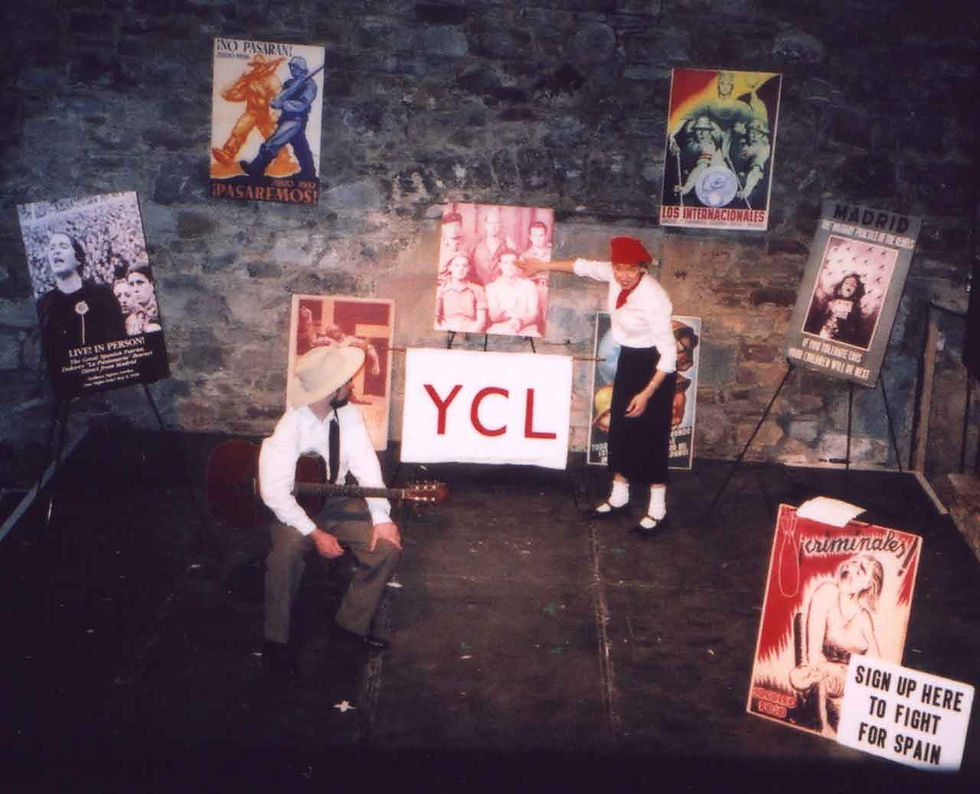
The setting is sparse but effective, emplying the stage as a lecture hall and drawing the audience into the action.
Perkins-Rabell plays a woman with a tender heart but an almost
simplistic nature, whose loyalty goes well past the borders of obsession. She made her commitments in her youth and will not surrender them, despite evidence to the contrary. [Boyd] plays her patient, loyal partner with a more measured view of history, supporting, and gently guiding her with quiet strength and grace.
Idealistic concepts rarely make a successful transition from theory to application. "Red Bessie" shows us a woman still enamored of her youthful ideals in a world that has become jaded.
Edinburgh Fringe Festival
Lauren Wood and John Barron
Comments from the Fringe
“The piece traces a line from the optimism of the 1930s, with the Lincoln Brigade on the march and new workers organizing all the time. to the repression and apathy of the consumer society and the Cold War. Use is made of original songs and correspondence; Bessie, the agitprop chanteuse in charge of things is based on a real person….[The play] is clear-headed and humane. not unaware of the hurt that political idealism can cause, and more fun than might be expected of such a high minded project.”
— Keith Miller, Times Literary Supplement, London. September 5, 2003
**** Four Stars: “Gilhooley and Czitrom’s play is extremely appealing in its refusal to take simple conclusions from history, sumultaneously celebrating and questioning the choice of those who chose to travel illegaly to Spain to fight Fascism…A brilliantly illuminating, frequently hilarious political show.”
—Ron Nissin, Three Weeks Magazine, London, August 2. 2003
**** Four Stars: “...a telling story of how youthful idealism moves towards mature disillusionment. But it is also a view of what ordinary people can sometimes do if they stand together, whatever their Governments may think. it’s a
clever two-hander this, working on several levels enhanced by a blend of contemporary and new songs.”
—Neil Ingram, Edinburgh Guide, August 8. 2003
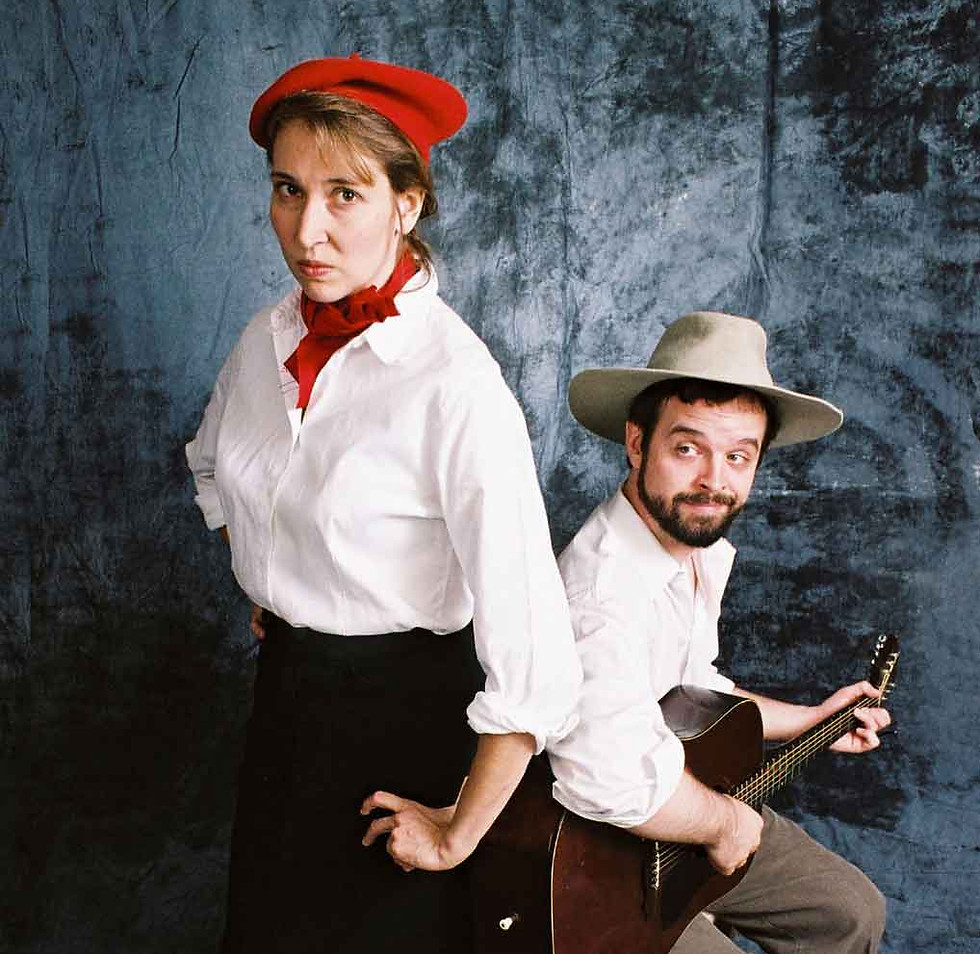
“Lauren Wood (Bessie) and John Barron (Bessie’s lover and fellow musician) do a fine job of performing the many songs from the American and international Left songbooks.”
—Mark Brown, The Scotsman, August 22. 2005
“… a three-dimensional heroine of the past, enviably seen in the two-dimensional present.”
—Ed Asner, Actor/Activist, 2003
Don't miss Jack's own story about the highs and lows of staging Red Bessie at Scotland's famous Edinburgh Fringe Festival, originally published in Sarasota Magazine: